
1918: Parliament Square, London
The Armistice: a strange and uncertain peace


The setting for this photograph is one that will be instantly recognisable to many people. The background is dominated by the jagged outline of the Palace of Westminster with the Clock Tower (now officially the Elizabeth Tower), home to the fabled ‘Big Ben’, rising high into the dreary November fog.
In front of the Palace the view opens out onto Parliament Square where the subjects, four wounded American servicemen, hold the Stars and Stripes in front of a bus belonging to the London General Omnibus Company. The date is November 1918.
Words by Peter Moore
Photographs Remastered and Colourised by Jordan Acosta

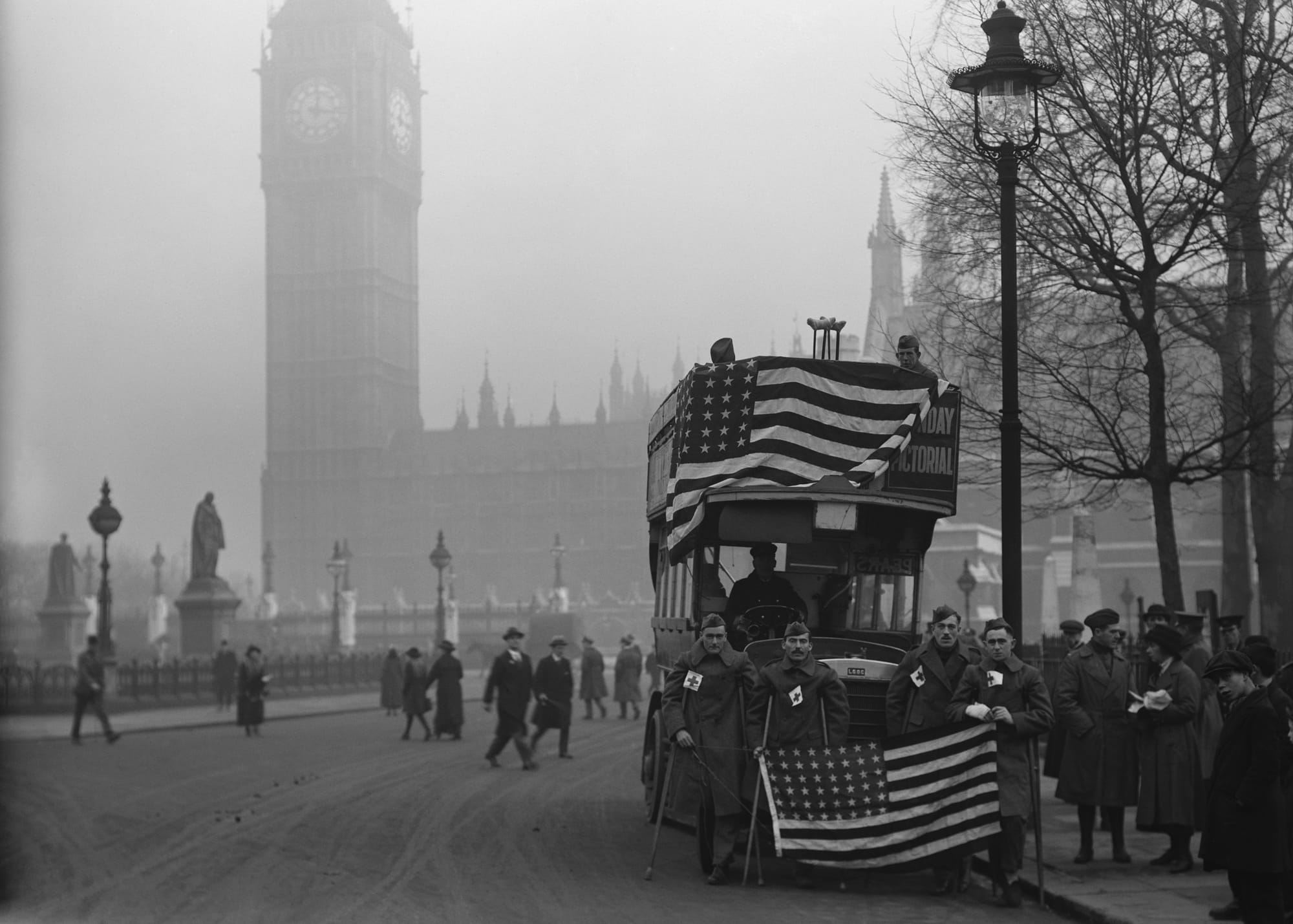
This is an extraordinary photograph. On technical and compositional grounds it is near flawless but what lifts it further still is its historical significance. It captures a complex moment in the history of the West. The Armistice of 11 November 1918 confirmed the triumph of the Allied Powers and the end of World War One. But it was a victory that had come at tremendous cost.
In Britain almost every community had been touched by the war. Some towns and villages had lost an entire generation of young men. The fates of many more were simply unknown. At the time of the Armistice, the whereabouts of almost a million British soldiers remained uncertain. Like Rudyard Kipling’s son John, thousands upon thousands had simply vanished into the mud and fire and chaos of the battlefields, never to be seen again.
The four American servicemen who stand before the omnibus, then, are among the fortune ones. They might be poised to return home, but their faces tell a story about where they have been. There is a coldness in them. A defiance. Their eyes are swollen. They display no element of triumph. The crutches that all four balance beneath their arms suggest the physical injuries they have obtained. Of their mental conditions, one can only wonder. In this age of fierce, destructive nationalism, they grip the American Flag.
13 November 1918
Folks Commission Will Visit England; On Tour of Southern England Mr. Davison Visits Sarisbury and Inspects Red Cross Farm (Photos); Getting Men Ready for Scotch Winter; Latest Arrivals; Boys at Dartford Thank Red Cross; Infant Welfare; How Red Cross Mule Fought the Germans; Red Cross Magazine; Love Letter of an Unknown Solider by Nora S. Heald; With The Red Cross in England by Captain Herbert S. Johnson; Isabel McIntyre of Islay; Fine Seaside Site for Naval Hospital; Explaining the Britishers; Red Cross Wedding; Hats Off to Them; Substitute for Cotton; Lord Mayor's Thanks; King Albert's Gift.
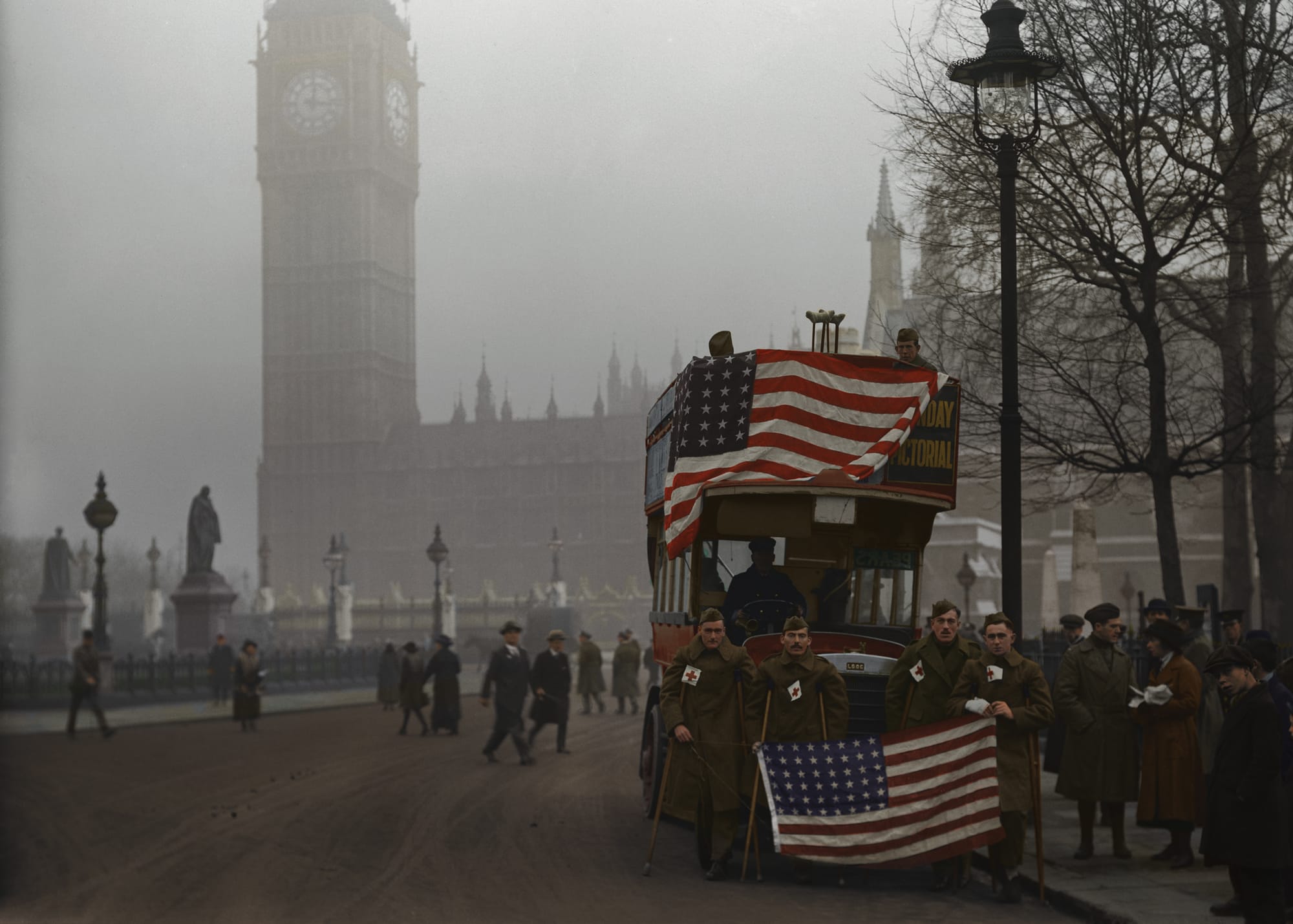
This photograph has two distinct atmospheres. Firstly, there is that of the dank November day with London’s infamous smog blurring the spires of Charles Barry's Gothic masterpiece. The deep cold of winter, though, has not yet arrived. No one has seen fit to pull on their gloves and thick winter coats. We can see that the leaves have all fallen, however, from the tree on the right side of the frame.
But as historians we are taught to pick out the deeper atmosphere, the emotional climate if you will, that underpins a photograph like this. Looking at this picture one can detect an earnestness. People stride purposefully; conversations are snatched on the pavements. But the overall tone is sombre rather than enthusiastic, reflective rather than relaxed. Caution overrides any trace of triumphalism. It is an odd sort of peace.
This shot in particular was just spectacular and I knew I had to do it. It happily coincided with filming for France’s national television station TF1, so we shot the segment on location between groups of tourists. The view remains largely unchanged though I cannot imagine what it must have been like to have been in London on this day just over a hundred years ago. – Jordan Acosta
Not far away from the place where the soldiers stand, the politicians were responding to this mood in their own way. On 11 November, the Prime Minister, Lloyd George, had come to the House of Commons to read the Armistice Statement. He had been met by excitement, but, as the following newspaper report shows, he decided not to encourage any sense of celebration:
12 November 1918
Long before the time for the opening of Parliament, all the approaches to St. Stephen’s were packed with an enthusiastic multitude. In the Chamber the Premier’s entrance was the signal for tumultuous cheering. The business of the day was set aside, and the Premier rose immediately. There was nothing rhetorical about Mr. Lloyd George’s speech. He read over the terms of the Armistice rapidly, just as he did when he announced the terms of the Austrian Armistice. Nothing was done for effect. Nothing was necessary, Having finished the recitation, the Premier remarked that this was no time for words and proposed that the House should proceed to St Margaret’s [Parliament’s church, where they had last gathered on 4 August, 1914] to give reverent thanks to God for the great deliverance from the war.
Outside the chamber, in the days that followed Lloyd George’s speech, we can imagine the four wounded American soldiers gathering in front of this omnibus, capturing a poignant moment in time •
This Snapshot was originally published November 10, 2023.
Ad: Unseen Histories relies on your patronage to operate. Our webstore offers a wide range of collectible museum-grade fine art prints, hand-printed in England for your wall space.
ColorGraph™ presents the most incredible colorized photography bringing the past to life. From start to finish, a ColorGraph print is made with exceptional care and attention. To mark its provenance, we emboss each one in the final stage of the hand-finishing process.
📸 Dive into our Features
🎤 Read Interviews
🎧 Listen to Podcasts
🖼️ Buy fine art prints & more at our Store


