
1917: Johnny Reynolds, 'Human Fly', Thrills Crowd
On Wednesday 5 September 1917, the daredevil climber Johnny Reynolds performed in Washington D.C.


As a crowd of 5,000 watched on, Johnny Reynolds ‘the human fly’ performed a thrilling series of tricks on the roof of a Washington D.C. building on 5 September 1917.
By the time of this feat, Reynolds was well known across the United States. He was variously described as ‘a daredevil’, ‘the Man Who Defies Death’, the ‘Sensational Novelty Gymnast’, ‘The Lizard’ and, increasingly by 1917, ‘the Human Fly’.
Words by Peter Moore
Photographs Remastered and Colourised by Jordan Acosta

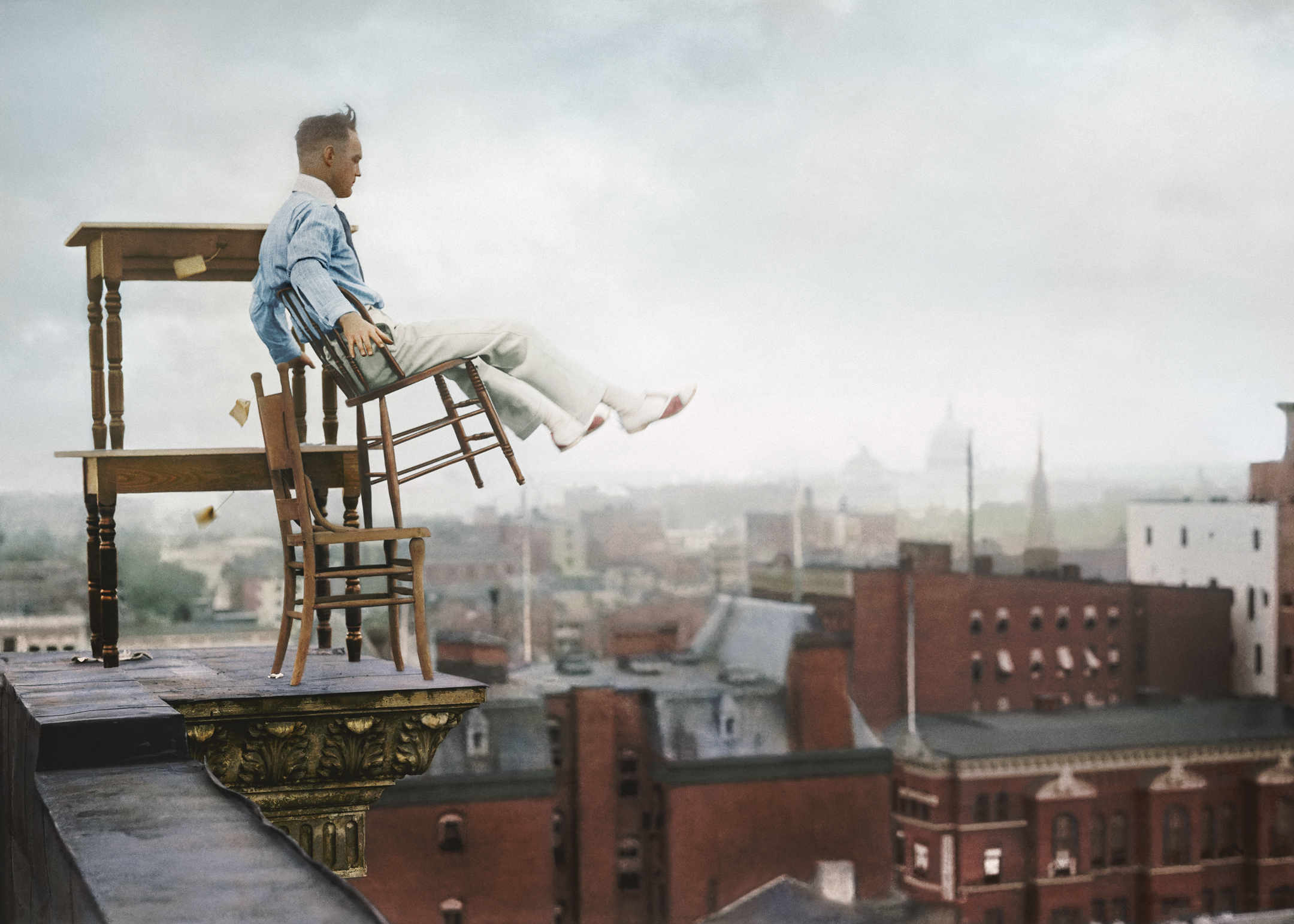
On that day in Washington, the crowd experienced the truth of these claims for themselves. With a fresh wind blowing, Reynolds commenced his tricks.
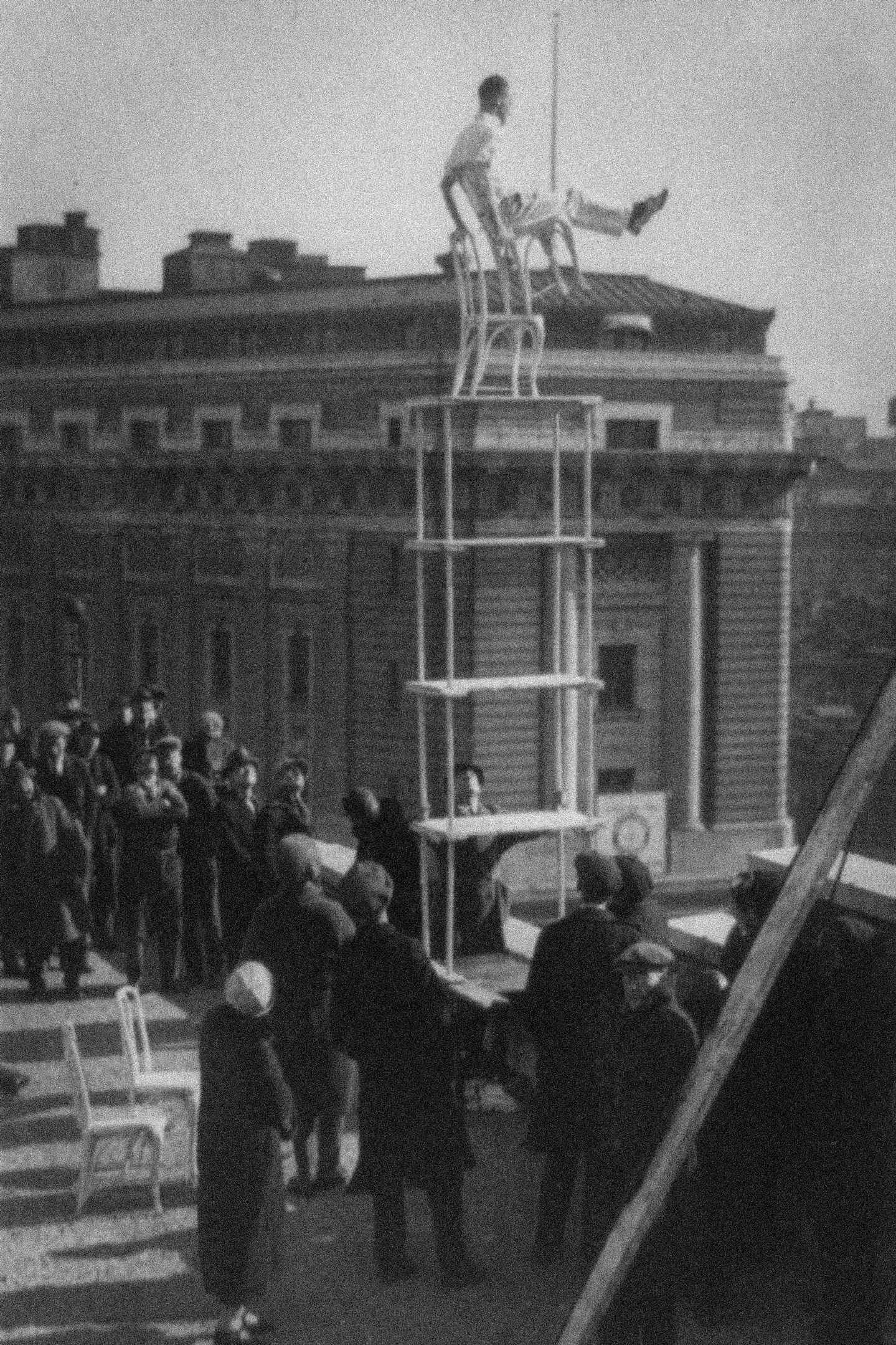
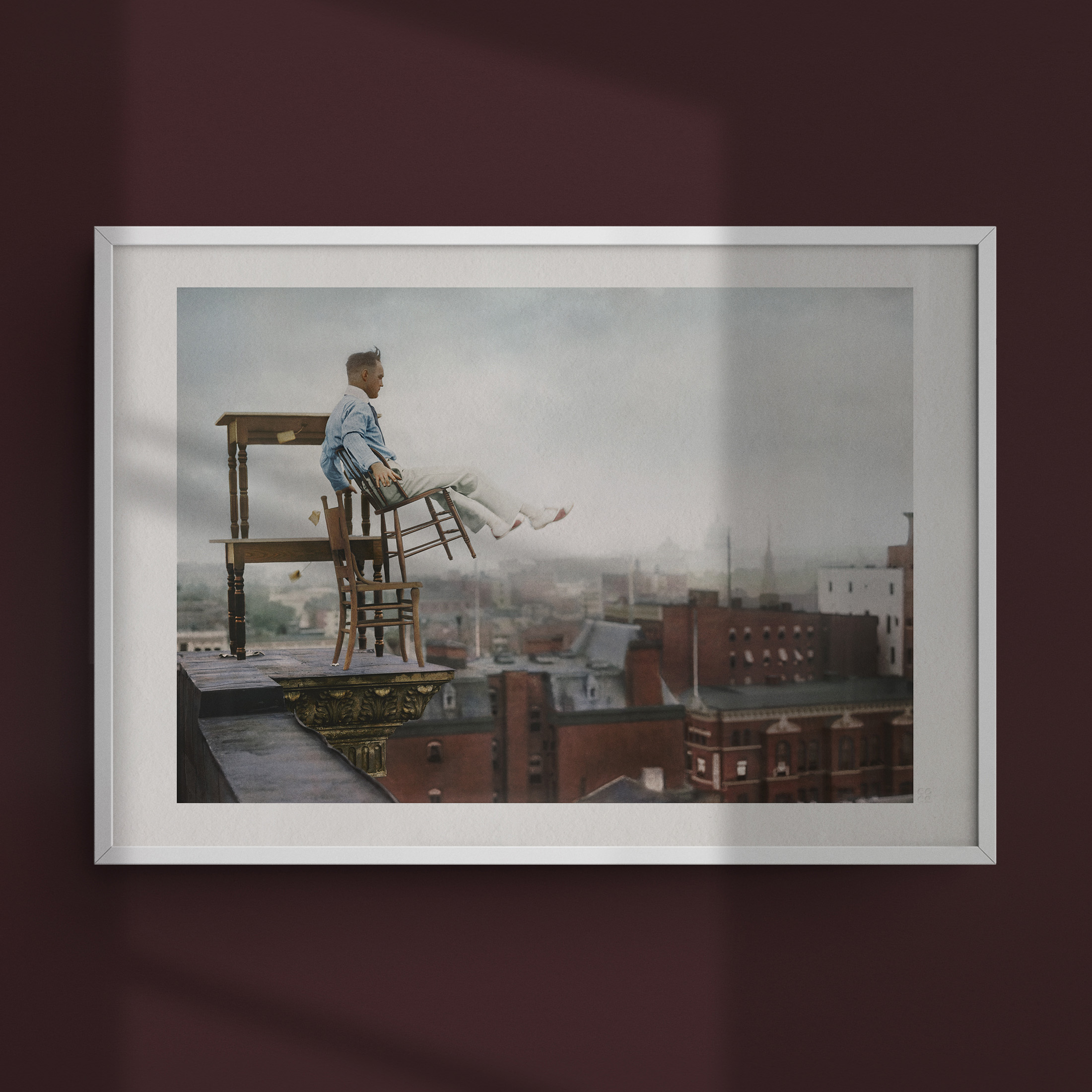
In one of these, Reynolds attempted to balance on an improvised tower of domestic furniture. The crowd below held their breath as Reynolds stacked two tables, one on top of the other.
Next came a couple of chairs. Reynolds placed the hind legs of one upon the seat of the other and then he climbed to the top. Sliding onto the seat, he stretched out his hands and legs to gain a balance. His hair flapped in the breeze.
A photographer buzzed around in this 'highly perilous' environment as Reynolds worked. Running to and fro on the narrow ledge on which the pyramid of chairs and tables stood, the photographer captured Reynolds from every angle.
One of these shots is the one you are looking at today. It is somehow both elegant and hair-raising. It frames Johnny Reynolds - a forgotten twentieth-century figure - in a pose that once thrilled a generation.
Not much is known about the early life of John H. Reynolds. Some sources claim that he came from Chicago, Illinois. Others that he was born in Buffalo, New York, in 1888. Whatever the case, it it clear that 'Johnny' as he was generally known, was a high-spirited, wiry young boy.
Fearlessness might well have run in the blood. Reynolds's father was said to be a steeplejack and it was he, apparently, who accompanied Johnny on his first public appearance. Then, aged just five, Johnny and his father dangled from either end of a long rope that had been fastened to a 140 flag pole.
Other stories maintain that he was once a diver at a local fairground and that, at length, he took up tightrope walking 'and was one of the few who did not use a net under his wire'. Juggling was said to be another passion and Johnny certainly spent time in Vaudeville - America's equivalent to Britain's 'music hall'. Eventually, however, Reynolds 'conceived the idea of clambering over buildings for exhibition'.
This turned out to be a winning idea. The early twentieth-century was a time of steep population increase in the United States. where teeming cities like New York or Chicago were being reshaped by the appearance of 'skyscrapers'.
From 1912 onwards, Reynolds's feats of daring started to attract public notice. Among the buildings he scaled included the City Hall in Philadelphia, the Flat Iron and Metropolitan Life Building in New York and the Taft Hotel in New Haven.
6 November 1916
A half hour before the scheduled time, Saturday afternoon a crowd of people gathered at the appointed place. It was a big crowd. They waited patiently and as the hour drew near some began to get anxious. They said, ‘He’s a fake, he’ll never show up’.
At 4.20 Reynolds came dashing up in a public taxi. Jumping from the car he doffed his hat and coat and after procuring the chairs and tables, walking into the center of the street.
Johnny who has long flaxen coloured hair, is of medium height and of slender build. He made an announcement stated that he had done a stunt similar to the one he would do here on the tall buildings of many cities, including Philadelphia, New York, Chicago and Paris.
Next he went through the crowd with his hat in hand requesting contributions from his audience. It is estimated that the collected between $10 and $15.
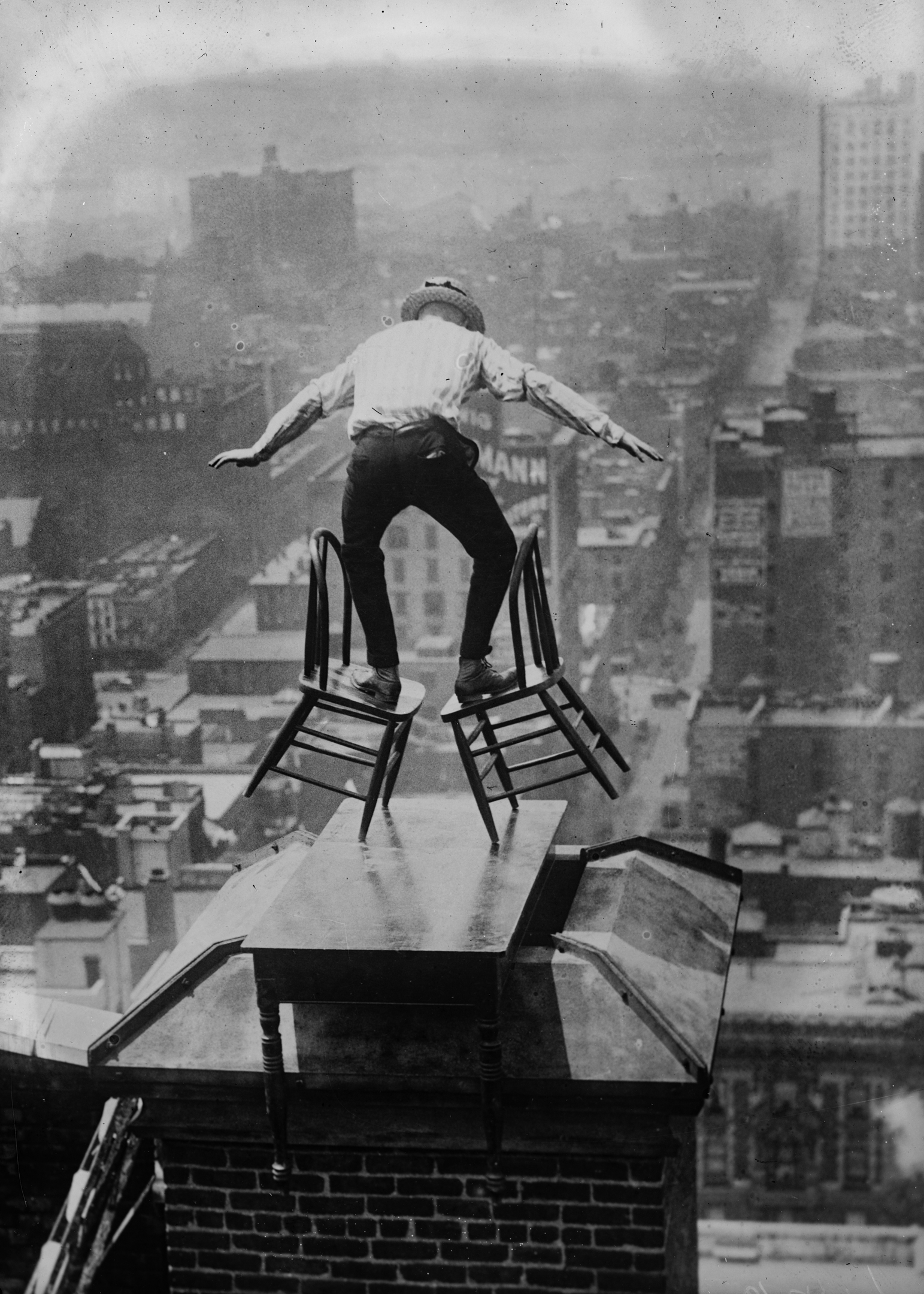
Johnny, minus his shoes, coat and hat, raised himself by means of a rope from the street level to the top of the building. He rested as he went on the window ledges. He balanced himself on two chairs standing on their legs.
Then he placed one chair on top of the other and he stood on their legs. Then he placed one chair on top of the other and he stood on the top one, balancing over the edge of the roof. Next he placed the two chairs sideways and balanced them on the front legs.
Then he balanced on the top two tables, placing first the chairs with the fronts together, and then placing one on top of the other and swinging out over the roof at a dangerous angle.
A stiff breeze was blowing all during Reynold’s act. The crowd applauded him and walked away feeling satisfied with the performance.
By the time of his stunt in Washington D.C. in September 1917 (pictured in the header above, colourised below), Reynolds was known throughout the eastern part of the United States. The identity he had coined was that of a sort of proto-Spiderman, 'The Human Fly'. This was new and exciting and for several years it provided Reynolds with a living.
But these were disturbed times. The Great War in Europe deepened as Reynolds's career progressed. In September 1917 his performance in Washington D.C. had a dual purpose. As ever he wanted to delight the crowds and earn some money; but equally he wanted to demonstrate to the military chiefs in Washington that he had the bravery and dexterity to become a 'United States Flyer'.
Reynolds was a natural candidate for the Aviation Section of the U.S. Signal Corps. He was still relatively young, in his late twenties, fit, brave and motivated. By early 1918 he had enlisted as Private Reynolds of the 212 Aero Squadron, a unit that was based at Kelly Fields near San Antonio in Texas.
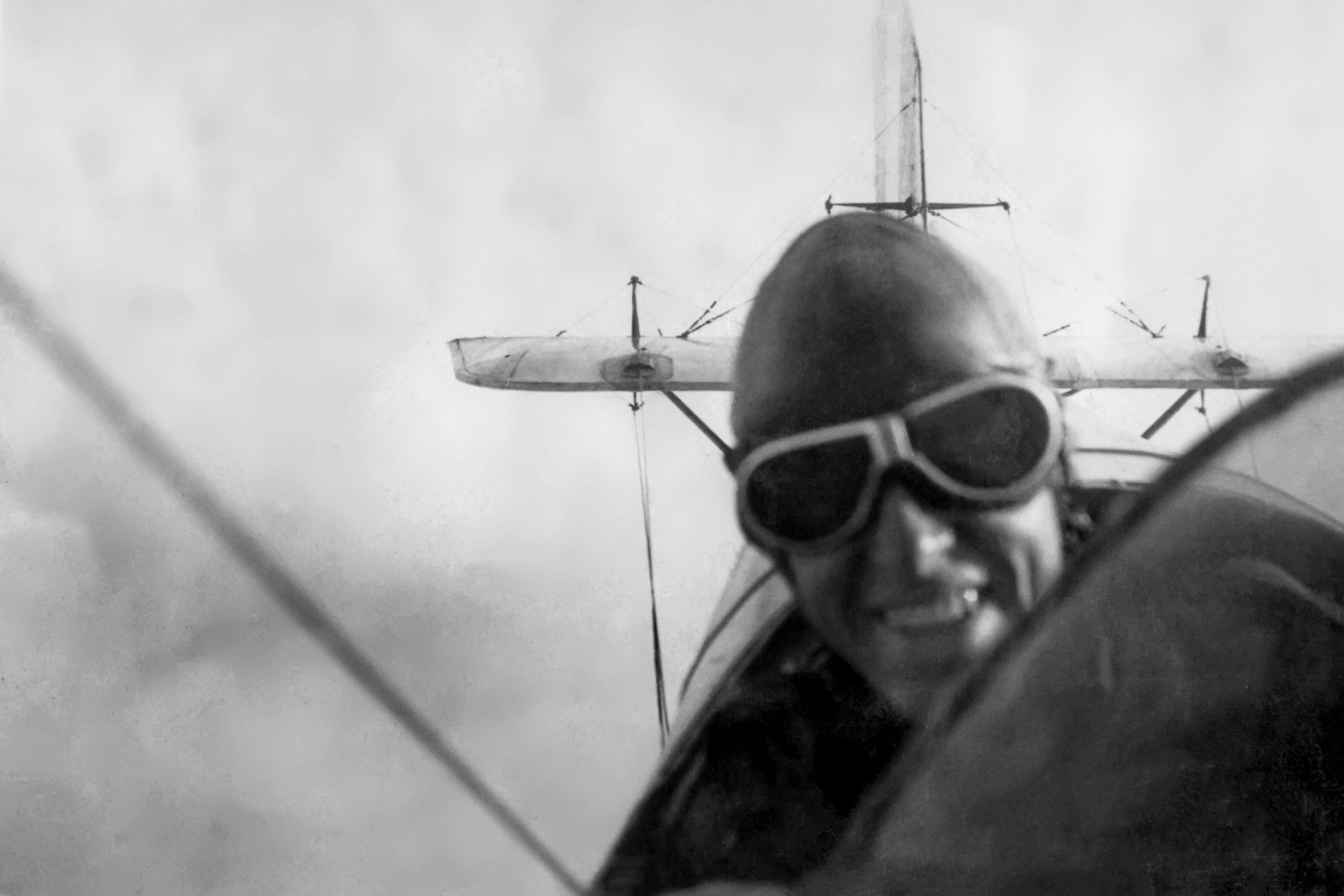
There was another daredevil in the 212th, too, a parachutist and aeronaut called Rodman Law and it was said that Reynolds and Law soon became a 'loving pair'.
Texans were soon aware of Reynolds's presence in their state. A piece in the Austin American Statesman remarked that:
Since entering the army, the daredevil has occupied the unique position of being safe in the service than he was in his former vocations, and it is very probable that an insurance company would consider him a better ‘risk’ even if he was in a front line trench, than it would if he had continued his hair-raising stunts in civilian life.
Taking a leave of absence, Reynolds left his barracks at Kelly Fields and scaled the Littlefield Building in Austin. While there, he stated that his next target would be the Eiffel Tower. He would do this, Reynolds claimed, as soon as he arrived in France.
The war ended, however, before Reynold could cross the Atlantic. This robbed him of his chance to reach a new European audience and perform on the great buildings of old Europe. In Texas, however, he remained a pioneer. Reynolds repeatedly claimed to be the world's first aerial acrobat, 'performing stunts' long before any 'other performer, army or civilian, thought of the idea.'
During this time Reynolds reportedly became the first aeronaut to leave one plane and enter another in flight, without the use of any mechanical aids.
Once the war had formally concluded, Reynolds was honourably discharged from the 212 Aero Squadron. Returning to his home in Philadelphia he soon reverted to type, promising to scale the 344-foot Morris Building and ride a bicycle around the stone topping.
Thousands continued to see him perform such feats and in the 1920s, as the Silver Screen Era progressed, movie fans saw him on Pathé Weekly. His fame now stretched beyond America. A picture of Daredevil Johnny Reynolds perched perilously over Manhattan's streets was printed in Britain's Daily Mirror.
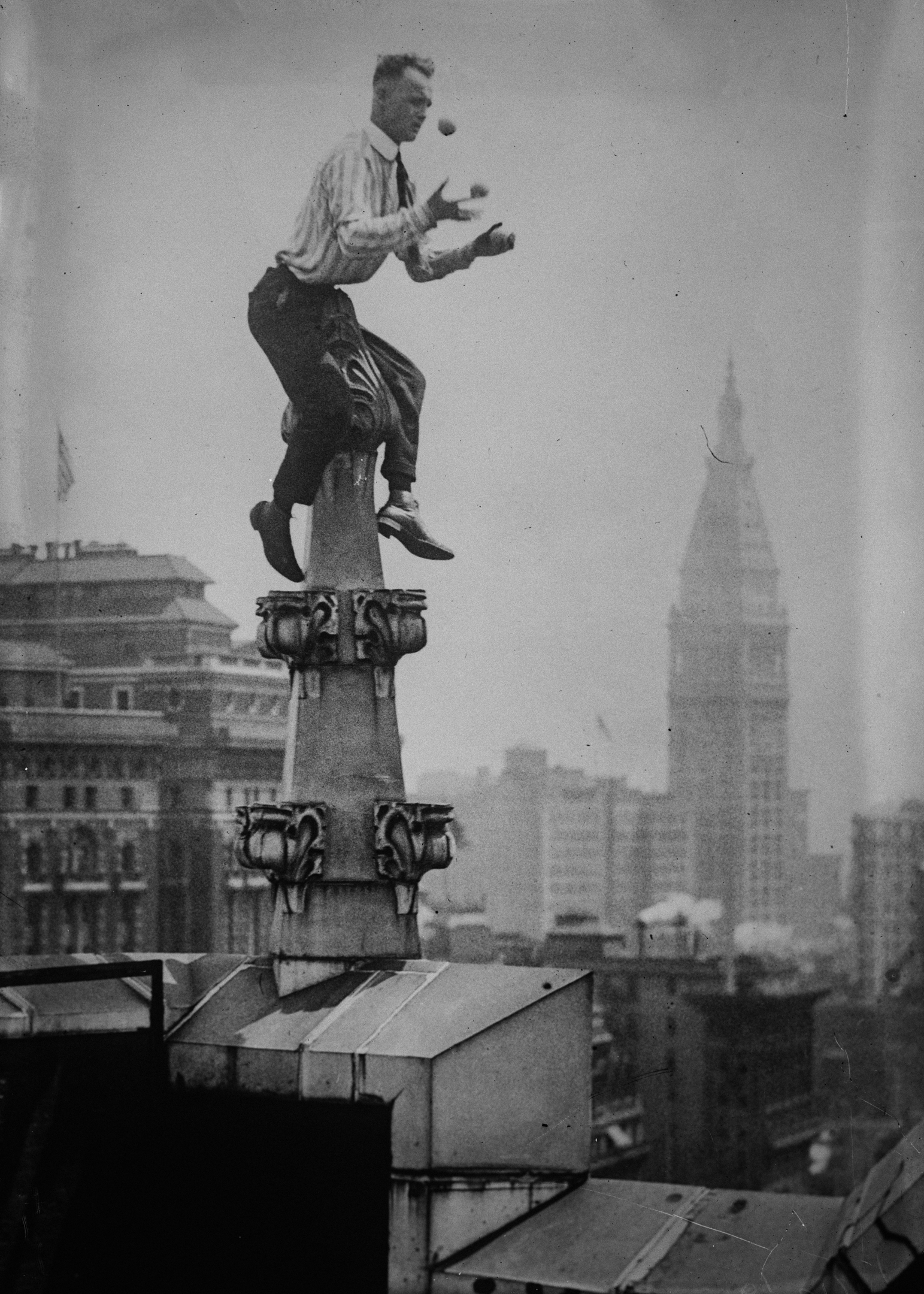
By this time, however, there was a sense that his powers were waning. Reynolds was now in his mid-thirties and he had suffered various accidents. In March 1923 he fell ten stories in Philadelphia, but was saved when he landed on a passing automobile. Around the same time he survived a five storey fall in Los Angeles. He broke his leg in this episode, but he was soon back at work.
It seems that Reynolds attempted to conceal news of these near misses, perhaps wanting to retain his reputation for invincibility.
Speaking to a journalist in Tampa in 1923, Reynolds said that he had only ever suffered one fall. And even in this episode—while climbing a 'smokestack' in Chicago—he had emerged unscathed.
26 November 1923
Johnny Reynolds: ‘I had climbed the smokestack of a big laundry in Chicago and having reached the top of the stack had balanced myself on one foot on top of it.
I felt the smokestack begin to sway and then suddenly to lean. You can imagine my sensation. I knew what was happening. The falling smokestack was preparing to catapult me from a height of 360 feet into Lake Michigan.
It is all bunk that you don’t think when you see death facing you. I stared it right in the face in that awful minute that it took the stack to fall. I was clinging for dear life to the stack, my hands clutching the rigging, waiting for the crash. I saw that the stack and myself were going into the lake.
As quick as a flash I was planning a way of escape. Almost automatically I jumped clear of the stack and the rigging when about twenty feet from the lake and dove into the water about ten feet from where the stack fell.
The crowd rushed out there expected to find me dead, but I swam ashore, and have been scaling buildings and doing other climbing stunts ever since.’
Whether Reynolds was telling the truth or not is difficult to gauge at a century's distance. His life was a performance and 'The Human Fly' was its carefully crafted heroic character.
It was only at the very end that the mask slipped. At the start of December in 1926 it was announced that Reynolds had died of natural causes at a hospital in Pennsylvania. According to the news report, he was thirty-eight years-old and, in a gentle twist to a tumultuous story, he had spent most of his life living with his parents in western Philadelphia •
This Snapshot was originally published January 17, 2025.
Ad: Unseen Histories relies on your patronage to operate. Our webstore offers a wide range of collectible museum-grade fine art prints, hand-printed in England for your wall space.
ColorGraph™ presents the most incredible colorized photography bringing the past to life. From start to finish, a ColorGraph print is made with exceptional care and attention. To mark its provenance, we emboss each one in the final stage of the hand-finishing process.
📸 Dive into our Features
🎤 Read Interviews
🎧 Listen to Podcasts
🖼️ Buy fine art prints & more at our Store


