
Sixer for Twenty-seven Years
What happens when an enemy intelligence officer walks through the door?


Beware of Russians bearing gifts. Defectors are not always welcome. Is the information they bring worth the cost of protecting them for the rest of their lives? Is it even genuine? Might they be double agents?
Veteran espionage writer Gerald Seymour introduces us to the scalp-hunters, the foot soldiers working on the ground to assess the intelligence on offer.
With an introduction by Gerald Seymour

The first problem when an 'enemy's' agent walks in through the door and claims he wants to defect is deciding if he is real, what he says, or is merely a 'dangle' and there to learn what you know already and to identify your best intelligence interrogators and analysts.
The quickest way to find a way out of the problem is to study your enemy's reaction. The clearest sign that joker who has dumped himself in your arms is the genuine article is if 'they' come after him, look to kill him ... as Russia did with Litvinenko and with Skripal. 'They' hate traitors.
The foot soldiers in my story are the ordinary veteran squaddies from Russia, rough men who expect to do a job of work, and on the British side are pretty much identical men, toughened with the similar combat experiences, who will look to block them, and even turn the tables upside down. Guiding, moving the pieces on the board, are the Controllers who play God with those ordinary folks' lives ... on our side that is Jonas Merrick: a little fellow from suburbia, goes unnoticed in a crowd, seems almost shy - and is fashioned as hard as an axe head.t.
– Gerald Seymour
For references please consult the finished book.
November
“What’s the bet he’s a dangle?”
“You reckon? A dangle?”
“Could be.”
“It’s a tasty one for them. Drop him in, lead us on a song and dance. Waved in front of us and we leap up like it’s Christmas come early. Well briefed on what to look for, listen for. Learns what we know, then does a runner. That’s what I call a dangle.”
Wally said, “Looks cocky enough, doesn’t he?”
Doug said, “Cat with a bowl of cream.”
“And us running around after him like blue-arsed flies.”
Neither were well humoured. Both had been roused out of their pits a little after three in the morning. It should have been Doug’s youngest’s birthday party later that day and should have been a visit to a store with his wife for Wally to look at a tumble dryer before the present one burned their home down. They were private military contractors: hired muscle. They were where the employment was. One was a former Royal Marine and the other had been a Protection Officer with the police up north. They had been at the airport at six, had been met by Frances, who’d seemed calm enough and clean and smart in a neutral way. In the departure lounge they’d shared the use of an electric razor and been on the first flight of the day to Copenhagen. Had been picked up at the airport by the team from the Denmark station – Griff and the Embassy security guy, Brian – and driven to the hotel, rather nice, decent view out over a bay. He’d shown up about an hour later.
The two of them, Wally and Doug, might have been at a county agricultural show, examining a bullock in the ring. It came from proven and tested land and should have been the proper business. If it were the proper business, then this bullock was doing a handsome job of confusing them.

He had introduced himself as Igor. They’d spotted him when he had driven into the hotel parking area. He’d taken a grip bag out of the boot, then had slammed down the lid as if he were no longer the proud owner of that topselling little Japanese car, not important to him any longer. He’d looked around him briefl y, checking to see he was not tailed. Wally knew the Service jargon better than Doug did. Wally had suggested the guy could be a “dangle”, but earlier had muttered something about competent “dry cleaning” ... It was the sort of talk that they enjoyed when having a quiet beer somewhere far from eavesdroppers, and both could take the piss out of their employers and the language that the staffer spies used which was thought to enhance elitism. Wally could handle any weapon from an antitank missile launcher through a heavy machine gun and down to a marksman’s rifle. Doug was blessed with good eyes and fast hands and preferred a Glock 9mm pistol and an H&K shortrange assault weapon. They were not armed. Had nothing between them other than competent unarmed combat drills. It would have been comforting to have had some sort of fi rearm tucked into a belt and out of sight below their heavy fleeces, if only because he was a Russian, bent – so he had said – on defection, and there must have been a chance that his brothers and sisters in their Embassy would come after him and not been coy as to what methods of force they’d employ to get him back. Two of the Danish PET boys, perimeter security they supposed, were lounging in chairs outside the room that had been arranged for them; they’d have had firepower, but it would have been a moot point if they’d use it. Right at the start, Wally had run an eye over the PET boy pair and had said from the side of his mouth, “Don’t look much like Vikings to me ...” And had been answered, in a stage whisper, “They were Vikings a thousand years ago, a proper lot of water under that old bridge since then.” Brian, the Embassy security chief, would have carried gas and pepper stuff in the shoulder bag that dangled off him, but not a shooter. And time was ticking and they’d not be on the move before the heavy mob came into town.
Truth was, and Griff had already said it: “He’s brought next to nothing with him. I said to him last night that he should clear out every bloody file he could get his fingers into. The more the merrier. Paper and discs. Go for broke because he’s not going back, emphasised it. Had to have a complete clear-out of their system ... I mean, I knew of him, but he wasn’t a target. We didn’t rate him as an A-list celeb, only a bit of a gofer. There he was, and I’m on the beach walking the dog. Comes up to me ... bold as brass ... not furtive. ‘You are Mr Griffin? Yes?’ I must have looked blank, perplexed. ‘Come on, Mr Griffin, it is not necessary to be shy. Where I work, we have a good file on you, a fat file, and you are respected.’ I told him that he would need to excuse me as my dog needed walking. Did not faze him. ‘Mr Griffin, I think you should be quite pleased, I am ...’ Gave his name, and his rank, said he was GRU, and that he intended to defect to us in the morning, and I gave him the usual splatter about coming to an arrangement and staying in place – which he ignored. ‘No, Mr Griffin, it is tomorrow morning, and I am coming to you and no turning back and I will not look behind me. That is it, a decision made.’ So, then it was all the stuff about clearing out every file he could lay his hands on last night, enough for a wheelbarrow load, or three.”
That’s what Griff had said. They had heard the first questions that the station chief had put to the Russian, and the answers were in good English, clear sentences but not vernacular. First up was the answer that very little had come with him. He was an officer in the Military Intelligence section attached to the Embassy. He had the rank of major in the Glavnoe razvedyvatel’noe upravlenie, and he should have been a treasure trove. Both Wally and Doug had heard the response to the question “And what have you managed to bring out with you?” GRU was top of the pile, the best quality intelligence-gathering organisation they had in their Federation, but he had shaken his head and had said with a dismissive waft of the hand – as if it were a trivial matter – that there had been colleagues in the inner sanctuary of the Embassy on Kristianiagade, white stucco and modern, and he had not thought it prudent to be seen downloading, printing, stacking material in a bag, nor hitting the keys and filling a memory stick. He had brought very little with him, and that he had detailed. They had seen the frown knit deeper on Griff ’s forehead. The man had shrugged and had said that he had plenty to say, that he would be most useful and had launched into a brief monologue of attitudes and policies emanating from the current Kremlin apparatchiks.
They were brought more coffee and a plate of biscuits.
Wally said, “Thank you, ma’am.”
Doug said, “Grateful, miss, appreciated.”
Not a hint of a smile in reaction, but she told them in a clean, clear, quiet voice, “Actually I’m not called Miss, Ma’am, or even Frances. Always known as Frank ... Excuse me.”
Griff came over to them – looked in poor humour.
“Talked my head off, haven’t I? Need to know and all that crap, and I’m gossiping to a degree that would embarrass a good old-fashioned fishwife. Why am I spreading my supposed wisdom so far and wide? Talking too much because there’s bits not making the best sense, so I’m trying to bounce it all at you. Breaking every rule in the book, but you would have heard his responses. Could have read that off the front page of any British broadsheet. Can I tell you something, boys?”
“Feel free.”
“Unburden, usually the best way.”
Both were looking past Griff across the room. The Russian was standing at the window, had opened it wide, his elbow on the ledge. Rain spattered the arm of his jacket. He had already tossed three fag ends out of the window into the jungle of bushes below. There was a No Smoking sign by the window. He had a good head of hair, thick, with a haphazard parting, and his eyes were darting and his gaze penetrating so that he seemed to strip into the thoughts of those who watched him, and a strong nose that was bent at the bridge as if it had been damaged, and when his glance traversed them he seemed to smile as if he were everyone’s friend, except that these friends were now becoming boring and displaying indecision.
Griff said softly, “Just my fucking luck. Forgive the vulgarity, lads, but it’s how I feel. Pretty much at the end of my stipend with the Service, only half a year to go, and right now that cannot come fast enough. I’ve been a Sixer for twenty-seven years. Russia oriented for the last fifteen of them. In that time, I’ve never had a sniff of one, not a proper full-blown defector. I have propositioned, done the first feeble chat-up lines with about as much success as trying to seduce a Mother Superior. Never been near to getting one. Then this joker pops his head up over the fence. Got really excited, know what I mean. The Mother Superior gives me a come-on, that excited. Hot flushes at home last night, put a bottle of bubbles in the fridge for tonight after I’ve dumped him into your tender hands and the cavalry coming from Vauxhall. Off home and I’m the hero of the hour. I don’t think so. Think he’s left us with rather a problem” •
This excerpt was originally published April 20, 2022.
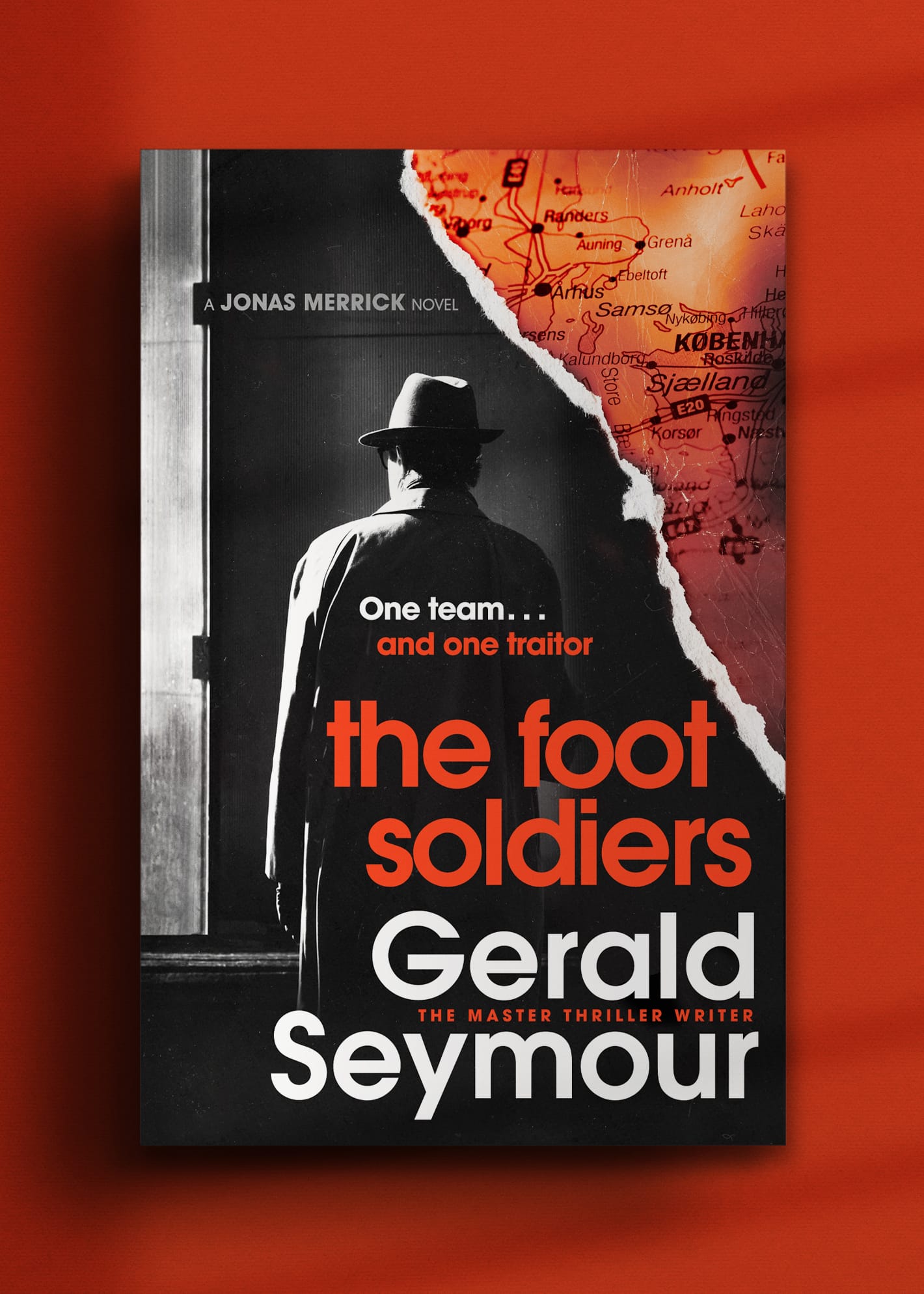
The Foot Soldiers
Hodder, 10 November, 2022
RRP: £9.99 | ISBN: 978-1529340440
“Strong echoes of George Smiley” – Financial Times
Beware of Russians bearing gifts. Defectors are not always welcome. Is the information they bring worth the cost of protecting them for the rest of their lives? Is it even genuine? Might they be double agents?
These are some of the questions facing MI6 when a Russian agent hands himself in to them in Denmark.
As a team begins to assess his value, his former employers in the Kremlin develop a brutal plan to show that no defector will ever be safe.
And they know where to find him. Which means there must be a mole in MI6.
So it is that the cavaliers of Six find themselves being interrogated by nondescript Jonas Merrick of Five - the man called back from retirement and his beloved caravan, the man the young guns call the Eternal Flame because 'he never goes out.'
But while he may be grey, Jonas is also ruthless. As he quietly works through the suspects in London, and violent mayhem breaks out in Denmark, Jonas plans not just to unmask a traitor, but to hit back at the Russians with deadly force.
First encountered in The Crocodile Hunter, Jonas Merrick is set to become one of the great figures of modern spy fiction.
“A novel of real quality. Top brass”
– The Times

Further Reading
Gerald recommends:
⇲ Mafia State by Luke Harding (Guardian Faber Publishing, 2021)
⇲ Red Notice by Bill Browder (Corgi, 2016)
A Time To Die (The Kursk disaster) by Robert Moore (Doubleday, 2002)
A Dirty War: A Russian Reporter in Chechnya by Anna Politkovskaya (Harvill Press, 2001)
With thanks to Steven Cooper.
📸 Dive into our Features
🎤 Read Interviews
🎧 Listen to Podcasts
🖼️ Buy fine art prints & more at our Store



